


Online Pharmacies Can Be Convenient, but Verification Matters
Online healthcare has made it possible to access pharmacy services without always visiting a physical pharmacy.
Depending on the service and your individual circumstances, you may be able to complete a health assessment online, communicate with a qualified healthcare professional and receive approved medication through delivery.
That convenience also makes it important to know who you’re dealing with.
A professional looking website alone doesn’t establish that a pharmacy is appropriately registered or that prescription decisions are being made by qualified professionals.
Before providing medical information or requesting prescription treatment online, take a few minutes to check the service carefully.
Start With the Pharmacy’s Registration
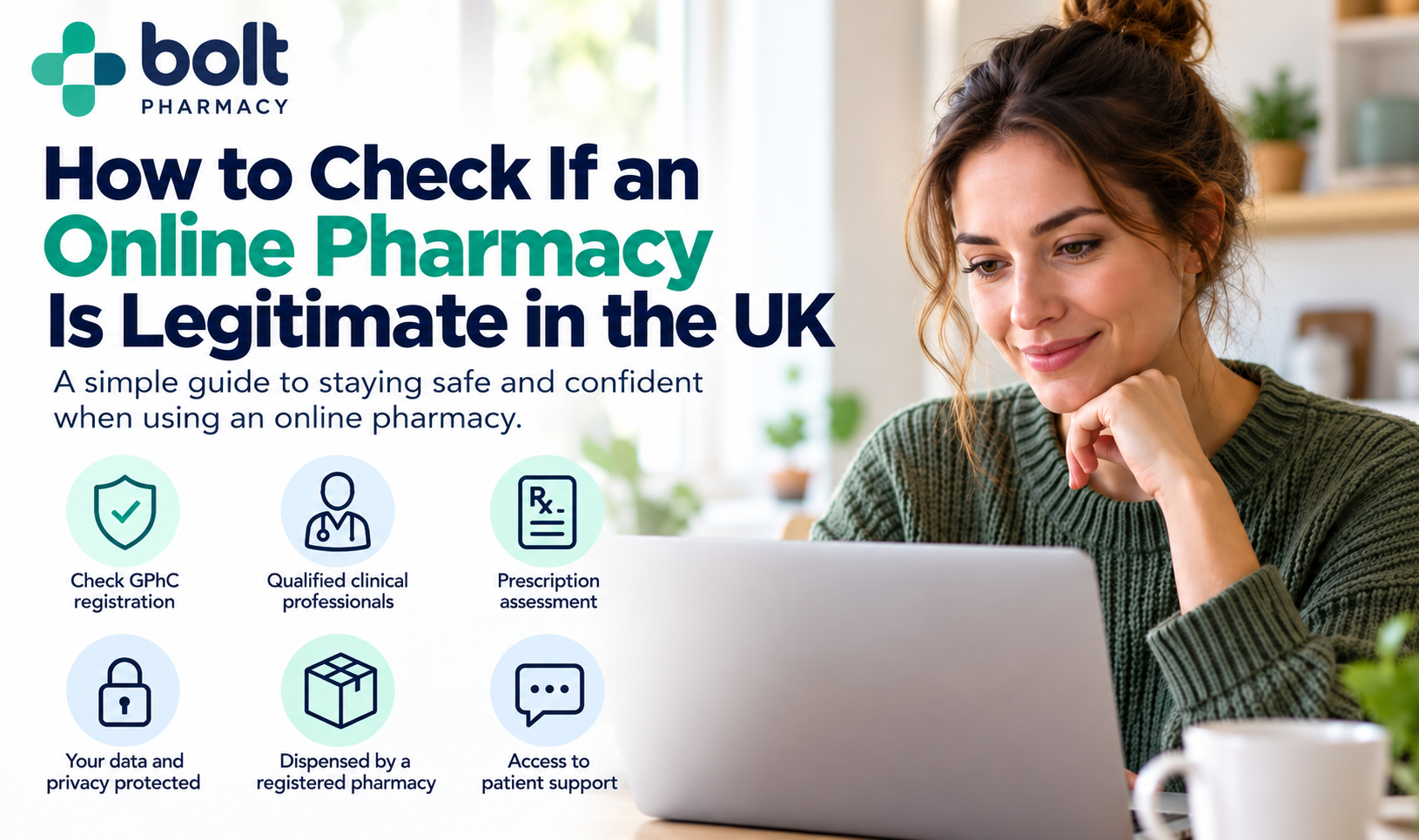
One of the most important checks for a pharmacy operating in Great Britain is its General Pharmaceutical Council registration.
The General Pharmaceutical Council, usually referred to as the GPhC, regulates pharmacists, pharmacy technicians and registered pharmacies in Great Britain.
A legitimate online pharmacy should make its registration information easy to find.
Look for details such as:
- Pharmacy name
- GPhC registration number
- Registered pharmacy address
- Superintendent pharmacist information
- Contact information
You can then independently verify the information through the official GPhC register.
Don’t rely exclusively on a logo displayed on the pharmacy’s website.
Check the registration itself.
Check Who Provides the Clinical Service
The pharmacy dispensing a medicine and the organisation providing the clinical consultation may not always be the same entity.
This distinction should be clearly explained.
When prescription medication is involved, look for information explaining:
- Who reviews your health information
- Who makes prescribing decisions
- What qualifications they hold
- Which organisation provides the clinical service
- How that service is regulated
Transparency is important when healthcare decisions are being made remotely.
A Prescription Should Require Clinical Assessment
Prescription only medicines shouldn’t simply function like ordinary online retail products.
A proper online prescribing process should involve an appropriate clinical assessment.
You may be asked about information such as:
- Medical history
- Current medicines
- Allergies
- Relevant symptoms
- Existing health conditions
- Other information relevant to the requested treatment
The exact questions will depend on the clinical situation.
The purpose is to provide the prescriber with information needed to decide whether a particular treatment is appropriate.
Be Accurate During an Online Consultation
Online healthcare depends heavily on the information you provide.
Don’t intentionally leave out medicines, medical conditions or other relevant details because you’re worried they could affect whether a prescription is approved.
Those details may be important for safety.
Answer health questions accurately and completely.
If you’re uncertain about a question, ask the clinical team rather than guessing.
Approval Should Never Be Guaranteed
A legitimate clinical consultation can result in treatment not being prescribed.
That’s an important distinction between healthcare and ordinary online shopping.
A qualified prescriber should be able to determine that a requested medicine isn’t appropriate for an individual.
Be cautious if a website appears to guarantee prescription approval before properly assessing your circumstances.
Clinical decisions should be based on suitability rather than simply completing a purchase.
Look for Two Way Communication
A health questionnaire can provide useful information, but there may be circumstances where a prescriber needs additional details.
A credible online service should provide an appropriate method for clinical communication.
Depending on the service, this could include:
- Secure messaging
- Follow-up questions
- Telephone communication
- Video consultation
- Access to a clinical support team
Healthcare shouldn’t feel like submitting information into a system where nobody can be contacted afterwards.
Understand Who Dispenses the Medicine
If a prescription is approved, the medication should be dispensed by an appropriately registered pharmacy.
The website should make it clear which pharmacy is responsible.
This is another reason to verify the GPhC registration rather than assuming the company name on the website tells the whole story.
Check the Physical Address
A legitimate online pharmacy should provide identifiable business and pharmacy information.
Look for a physical address rather than only a contact form.
You can compare that address with information shown on the relevant regulatory register.
If the information is inconsistent, investigate further before providing personal or medical information.
Look for Clear Contact Information
Healthcare services should provide a way for patients to ask questions.
Before using an online pharmacy, check whether you can find:
- Telephone details
- Customer support
- Clinical support
- Pharmacy contact information
- Complaint procedures
If something goes wrong with an order or you have a question about a prescribed medicine, you need to know how to contact the appropriate team.
Review the Privacy Policy
Online pharmacies may handle sensitive personal and health information.
Take a look at the privacy policy before submitting your details.
It should explain how information is collected, stored and used.
You should also be able to identify the organisation responsible for handling your data and find information about your data protection rights.
Privacy policies aren’t exciting reading, but they’re particularly important when medical information is involved.
Use Strong Account Security
If you create an online pharmacy account, protect it carefully.
Use a strong, unique password rather than reusing the same password you use across multiple websites.
Where additional security options are available, consider enabling them.
Remember that a pharmacy account may contain information considerably more sensitive than an ordinary shopping account.
Understand Identity Verification
Some online healthcare services may need to verify patient identity.
Identity checks can form part of ensuring that healthcare and prescription services are being provided to the correct individual.
The pharmacy should explain why information or identification is being requested and how it will be handled.
Read these explanations before uploading sensitive documents.
Be Cautious With Unrealistic Health Claims
A legitimate healthcare provider should not need exaggerated promises.

Be wary of claims suggesting that a medicine:
- Works for everyone
- Has no meaningful risks
- Guarantees a particular result
- Doesn’t require professional assessment
- Is suitable regardless of medical history
Medicines can have contraindications, interactions, warnings and side effects.
Individual responses can also vary.
Reliable healthcare information should acknowledge those realities.
Don’t Choose Prescription Treatment Based Only on Price
Cost matters, but it shouldn’t be the only factor when evaluating an online pharmacy.
A very low advertised price isn’t particularly useful if you don’t know:
- Who is prescribing
- Where the medicine comes from
- Which pharmacy dispenses it
- Whether the provider is appropriately regulated
- What happens if you need clinical support
Evaluate the entire healthcare service rather than comparing prescription medicine as though it were an ordinary consumer product.
Check What Happens After Treatment Begins
Clinical care doesn’t necessarily end once a parcel arrives.
Depending on the treatment, appropriate follow-up may be required.
Before using an online service, find out whether there is a process for:
- Follow-up questions
- Clinical reviews
- Reporting side effects
- Treatment changes
- Repeat prescriptions
- Ongoing monitoring
The exact requirements vary according to the medicine and individual circumstances.
Know When Online Care Isn’t Appropriate
Online pharmacy services can be convenient, but they don’t replace every form of healthcare.
Some symptoms require physical examination, diagnostic testing or urgent medical attention.
A responsible provider should be prepared to direct patients toward their GP, another healthcare professional or emergency care when remote treatment isn’t appropriate.
Don’t delay urgent medical care because you’re waiting for an online consultation.
Keep Your Regular Healthcare Providers Informed
Your GP and other healthcare professionals may need an accurate record of medicines you’re taking.
When appropriate, make sure relevant healthcare providers know about treatments prescribed through online services.
This is particularly important when you’re taking several medicines or receiving treatment for multiple conditions.
Be Careful With Social Media Advertising
Online pharmacies and healthcare companies increasingly advertise through social media.
An advertisement should never be the only information you use when making a healthcare decision.
After seeing an advert, investigate the provider independently.
Check:
- Regulatory registration
- Company information
- Clinical process
- Medicine information
- Privacy policy
- Contact details
Treat advertising as an introduction to a service, not evidence that the service is suitable for you.
Understand Prescription Delivery
Prescription medicines may have specific storage and transportation requirements.
Some products can be delivered through ordinary postal methods, while others require particular packaging or temperature controls.
The pharmacy should have appropriate procedures for the medicines it supplies.
When your medicine arrives, follow the storage instructions included with the product.
If a package appears damaged or you have concerns about how it was transported, contact the pharmacy before using the medicine.
Never Share Prescription Medicine
A medicine prescribed for one person shouldn’t be shared with somebody else.
The prescription decision is based on that patient’s individual health information.
Even if another person believes they have the same condition, their medical circumstances may be different.
They should obtain their own professional healthcare advice.
Watch for Counterfeit or Unregulated Sellers
Unregulated websites can expose consumers to significant risks.
Products sold outside legitimate pharmacy channels may not contain what they claim, may be incorrectly stored or may come from unreliable sources.
Warning signs can include:
- Prescription medicines offered without assessment
- Missing regulatory information
- No identifiable pharmacy
- No professional contact information
- Guaranteed prescription approval
- Extreme health claims
- Pressure to purchase immediately
When something feels questionable, verify the provider before proceeding.
Bolt Pharmacy’s Current Regulatory Information
Bolt Pharmacy is operated by Bolt Healthcare Ltd.
Its current dispensing pharmacy is registered with the General Pharmaceutical Council under registration number 9013085.
The pharmacy identifies Phuong Nguyen as its Superintendent Pharmacist.
Bolt states that clinical consultations and prescribing services are provided by AIOS Technology Ltd, a Care Quality Commission registered healthcare provider.
According to its published process, patients complete a health assessment before a qualified prescriber reviews the information.
The prescriber may ask additional questions and determines whether treatment is clinically appropriate.
If a prescription is issued, Bolt Pharmacy is responsible for dispensing the prescribed medicine.
This separation between clinical decision making and dispensing is explained on the company’s website and can be independently checked against the relevant UK regulatory information.
Verify Information Yourself
Even when a healthcare website provides registration numbers, independent verification is worthwhile.
For a UK online pharmacy, check relevant public registers rather than relying exclusively on statements made by the company itself.
Regulatory information can change over time.
Checking current information helps you make decisions using the latest available records.
A Simple Online Pharmacy Safety Checklist
Before using an online pharmacy, ask:
- Is the pharmacy registered with the GPhC?
- Does the registration information match the website?
- Can I identify the registered pharmacy address?
- Who provides the clinical consultation?
- Who makes prescribing decisions?
- Does prescription treatment require an appropriate assessment?
- Can a prescriber ask follow-up questions?
- Can treatment be declined when it isn’t appropriate?
- Is there a clear privacy policy?
- Can I contact the pharmacy or clinical team?
- Are health claims realistic and appropriately explained?
- Is there a process for follow-up care where necessary?
- Can I independently verify the regulatory information?
If these basic questions don’t have clear answers, investigate further before providing sensitive information.
Final Thoughts
Online pharmacies can make some healthcare services more accessible and convenient, but convenience shouldn’t replace appropriate clinical safeguards.
Before using any UK online pharmacy, verify its registration, understand who provides the clinical service and make sure prescription medicines require a genuine assessment by an appropriately qualified professional.
Bolt Pharmacy currently operates as a GPhC-registered dispensing pharmacy, while its clinical consultations and prescribing services are provided by a CQC-registered healthcare provider.
Those details are useful, but the broader lesson applies to any online healthcare service:
Check the provider, understand the process and never treat prescription medicine like an ordinary online purchase.

Theo Louse
I am Theo Louse. My skills are dedicated to the field of technology information and try to make daily lives more enjoyable. With more than 12 years of experience with BM, we are particularly famous for 100% self-developed ideas. Over these years, we have worked to make everyday life more convenient for the fast-paced world we live in.